Artificial Intelligence (AI) is transforming the way we live, work, and interact with technology. It is the simulation of human intelligence in machines designed to think, learn, and perform tasks typically requiring human intelligence. Understanding the basics of AI is essential for anyone looking to explore technology, business innovation, or digital transformation.
What is Artificial Intelligence?
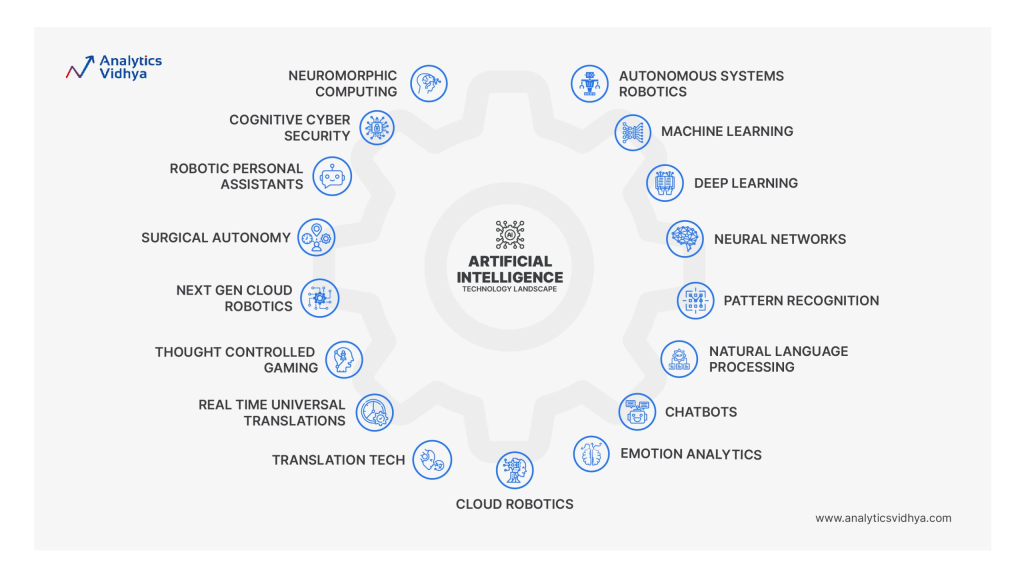
Artificial Intelligence refers to the capability of machines to perform tasks such as reasoning, problem-solving, understanding natural language, recognizing patterns, and making decisions. Unlike traditional software that follows explicit instructions, AI systems learn from data and experiences, improving their performance over time.
Types of Artificial Intelligence
AI can be broadly categorized into three types based on capabilities:
1. Narrow AI (Weak AI)
Narrow AI is designed for specific tasks. These systems operate under a limited scope and cannot perform tasks outside their programming. Examples include voice assistants like Siri and Alexa, recommendation systems on Netflix, and autonomous customer support chatbots.
2. General AI (Strong AI)
General AI has the potential to understand, learn, and apply intelligence across a wide range of tasks, much like humans. While still theoretical, strong AI aims to perform any intellectual task that a human can accomplish.
3. Superintelligent AI
Superintelligent AI surpasses human intelligence in all domains. It is capable of decision-making and problem-solving beyond human capabilities. This form of AI remains a concept and is the subject of ethical and scientific debate.
Key Components of Artificial Intelligence
AI systems rely on several critical components to function effectively:
1. Machine Learning
Machine Learning (ML) is a subset of AI that enables machines to learn from data without explicit programming. Algorithms analyze patterns in data, make predictions, and continuously improve over time.
2. Deep Learning
Deep Learning is a specialized subset of ML that uses neural networks to mimic the human brain’s structure. It is particularly effective in image recognition, speech processing, and natural language understanding.
3. Natural Language Processing (NLP)

NLP allows machines to understand, interpret, and generate human language. Applications include chatbots, language translation services, sentiment analysis, and voice-controlled assistants.
4. Computer Vision
Computer Vision enables machines to interpret and analyze visual information from the environment. It is used in facial recognition, autonomous vehicles, medical imaging, and augmented reality applications.
5. Robotics
AI-powered robots combine machine learning, sensors, and actuators to perform complex tasks autonomously. These robots are used in manufacturing, healthcare, logistics, and space exploration.
Applications of Artificial Intelligence
AI has widespread applications across multiple industries:
- Healthcare: AI assists in disease diagnosis, drug discovery, and personalized treatment plans.
- Finance: Fraud detection, algorithmic trading, and risk management benefit from AI.
- Retail: AI enhances customer experiences with personalized recommendations and inventory optimization.
- Transportation: Autonomous vehicles, traffic management, and route optimization leverage AI.
- Education: AI-driven platforms offer personalized learning, grading automation, and virtual tutoring.
Benefits of Artificial Intelligence
Artificial Intelligence offers several advantages:
- Efficiency: AI automates repetitive tasks, reducing human workload.
- Accuracy: Machine learning models can detect patterns and errors more accurately than humans.
- Cost Savings: Automation leads to reduced operational costs.
- Innovation: AI enables new products, services, and business models.
- Decision Support: AI provides insights from data, helping businesses make informed decisions.
Challenges of Artificial Intelligence
Despite its potential, AI faces significant challenges:
- Data Dependency: AI requires large volumes of high-quality data for training.
- Bias: Poorly designed algorithms can perpetuate biases in decision-making.
- Job Displacement: Automation may replace certain human jobs.
- Security Risks: AI systems can be vulnerable to attacks and misuse.
- Ethical Concerns: Issues like privacy, accountability, and control are critical in AI development.
Future of Artificial Intelligence
The future of AI promises smarter, more autonomous systems integrated into everyday life. Emerging trends include AI in quantum computing, brain-computer interfaces, and advanced robotics. Ethical AI development and regulatory frameworks will shape the responsible adoption of AI technologies.